

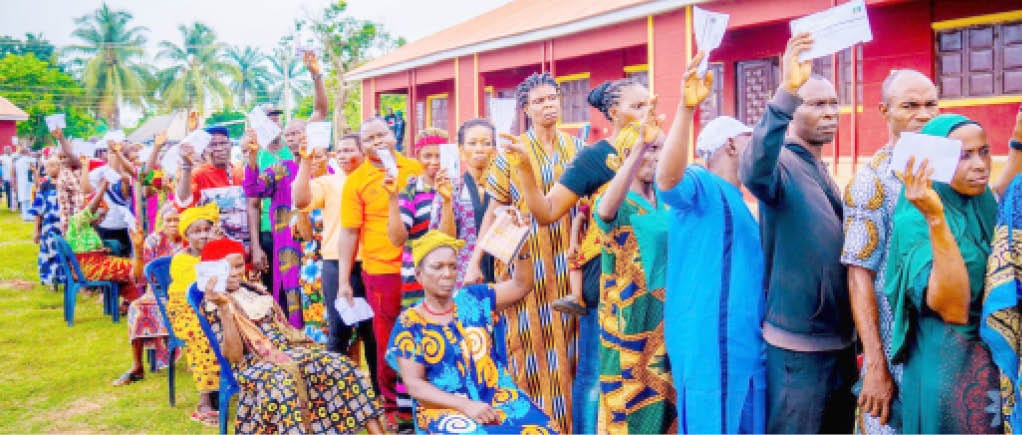
A survey by Yiaga Africa has revealed that 84 per cent of Nigerians say they are likely or very likely to vote in the 2027 general elections, but fear of violence, declining confidence in the Independent National Electoral Commission (INEC), and widespread vote-buying could prevent many from turning up at polling units.
This is according to the third round of Yiaga Africa’s National Voting Intentions Survey (NVIS 3.0), released in Abuja yesterday, which found that while Nigerians remain willing to participate in the elections, their commitment to voting remains fragile.
The report, titled “Willing but Wary: How Nigerians Intend to Vote in 2027,” was based on interviews with 2,470 Nigerians aged 18 and above across the 36 states and the Federal Capital Territory in September 2026.
For the first time, the survey included face-to-face interviews in rural communities alongside telephone interviews, tracking changes from the first two rounds conducted in December 2025 and March 2026.
According to the findings, the proportion of Nigerians who said they were likely or very likely to vote rose from 77 per cent in NVIS 1.0 to 73 per cent in NVIS 2.0, reaching 84 per cent in the latest survey.
However, those who described themselves as “very likely” to vote declined marginally from 52 per cent in the first survey to 48 per cent in the second and 47 per cent in the latest round.
The survey also found that only 41 per cent of respondents were likely to vote and very certain about their choice of candidate.
Yiaga Africa identified insecurity as the single biggest barrier to voter participation, with 61 per cent of respondents stating that fear of violence could prevent them from voting.
The survey also highlighted declining public confidence in INEC, with only 34 per cent of respondents expressing confidence that the commission would conduct credible elections, compared to 45 per cent in each of the two previous rounds.
It noted that 39 per cent of respondents lacked confidence in INEC, with distrust particularly high in the South-East (62 per cent) and the South-South (57 per cent).
Despite concerns regarding the electoral umpire, citizens appeared to have greater confidence in election technology, with 49 per cent expressing trust in the Bimodal Voter Accreditation System (BVAS) and the electronic transmission of results through the INEC Result Viewing Portal (IReV).
The survey further indicated that government performance and economic conditions would be decisive factors in determining voters’ choices in 2027.
It noted that 54 per cent of respondents disapproved of President Bola Tinubu’s performance, while 71 per cent rated the economy as poor or very poor.
The report also highlighted demographic differences, noting that younger Nigerians showed weaker voting intentions and higher levels of distrust in the electoral process.
Speaking on the findings, Yiaga Africa’s Head of Knowledge Management and Learning, Safiya Bichi, said Nigerians have not lost interest in elections, but several factors stand between their willingness to vote and actual participation.
“Nigerians have not given up on elections. They want to vote, they see it as their duty, and they believe their votes can make a difference,” she said.
She added: “What stands between that willingness and the ballot box is fear, distrust, and money.”
Bichi described low voter turnout in Nigeria as “a conversion problem, not an apathy problem,” emphasizing that the responsibility for addressing these challenges rests with institutions and actors in charge of security, electoral credibility, and logistics.
With the presidential election scheduled for January 16, 2027, Yiaga Africa called on the Federal Government and security agencies to publish a threat-based national election security plan through the Inter-Agency Consultative Committee on Election Security (ICCES) by November 2026.
It urged authorities to prioritise high-risk areas—particularly the North-East, North-West, and North-Central regions—and focus on protecting voters in addition to safeguarding election materials.
The organisation also called on INEC to make a public commitment to the real-time uploading of polling unit results to IReV, publish and test its results management protocol, and intensify confidence-building efforts in the South-East and South-South.
It urged the judiciary to resolve pre-election candidacy disputes before ballot papers are printed and publish clear timelines for the determination of election petitions.
Political parties and candidates, it added, should campaign on fully costed plans for security and the economy, sign and honour the Peace Accord, and commit to an enforceable anti-vote-buying pledge.
Yiaga Africa also urged civil society organisations and the media to shift voter education from merely encouraging citizens to vote to providing greater assurance regarding the safety and credibility of the electoral process—particularly among young people, women, and underserved communities.
UPDATE NEWS:
Nigerians can now invest ₦2.5 million on premium domains and profit about ₦17-₦25 million. All earnings paid in US Dollars. Rather than wonder,
click here to find out how it works.