
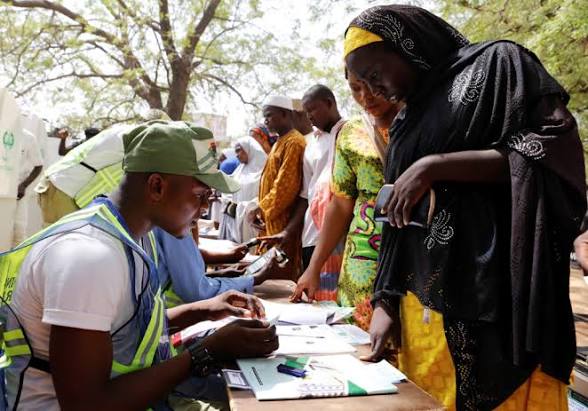
No fewer than 84 per cent of Nigerians say they are likely to vote in the 2027 general elections.
However, concerns over insecurity, trust in the electoral umpire and the credibility of dispute resolution remain a major challenge.
This was revealed by a new survey championed by Yiaga Africa.
The findings were contained in the organisation’s National Voting Intentions Survey 3.0, launched in Abuja on Wednesday.
The survey, conducted in September 2026, involved 2,470 Nigerians aged 18 and above across the 36 states and the Federal Capital Territory, with 2,066 respondents interviewed by telephone and 404 through face-to-face interviews in rural communities.
According to the report, 47 per cent of respondents were “very likely” to vote, while 61 per cent said fear of violence could prevent them from voting.
Insecurity remained the leading barrier to participation, with 82 per cent expressing concern that it could affect the 2027 polls.
Confidence in the Independent National Electoral Commission (INEC) also fell from 45 per cent in the first two rounds of the survey to 34 per cent in the latest edition.
The survey further found that 49 per cent of respondents trusted the Bimodal Voter Accreditation System (BVAS) and IReV result transmission, compared with 34 per cent who expressed confidence in INEC.
Meanwhile, 63 per cent said they had little or no confidence that the judiciary would resolve electoral disputes fairly, rising to 81 per cent in the South-South.
Speaking on the details of the report, Yiaga Africa’s Chairman, Board of Trustees, Hussaini Abdu, said the objective of the survey was not to pass a verdict on the elections or voters, but to identify ways to improve voter intentions ahead of the polls.
“It’s a wake-up call to Nigerians and to civil society organisations, and everyone that is involved in elections, that this election is very important to the country. It’s important for democracy. And there are some of the gaps that have been identified in this report, that we can work on,” he said.
Abdu also called on political parties to help encourage voter turnout, saying it would be unfair to repeat the 2023 election experience, when only 27 per cent of registered voters went to the polls.
“Political parties have a very important role to play in terms of mobilising their members and mobilising voters, to do their civic duty. That’s one of the founding responsibilities of political parties.
“And therefore, they have a role to play in ensuring that voters come out. It is not good enough that you have over 100 million people registering to vote, and then you have only 27 per cent like we had in the last elections, coming out to vote.
“Yes, our electoral system allows for simple majority, but it’s not fair on our democracy, for minorities, to actually be voting our leaders,” the chairman added.
Speaking on the release, Yiaga Africa’s Head of Knowledge Management and Learning, Safiya Bichi, said the findings showed that although Nigerians had not given up on elections, “fear, distrust and money” remained major factors standing between them and the ballot box.
She described low voter turnout as a conversion problem rather than an apathy problem.
“Nigerians have not given up on elections. They want to vote, they see it as their duty and they believe their votes can make a difference. What stands between that willingness and the ballot box is fear, distrust and money.
“Low turnout in Nigeria is a conversion problem, not an apathy problem, and the responsibility for fixing it lies with the institutions and actors who control security, credibility and logistics. With the presidential election on 16 January 2027, the window to act is short,” she stated.
The Executive Director of the Peering Advocacy and Advancement Centre in Africa, Ezenwa Nwagwu, described the 84 per cent likely voter figure as a positive development, saying stakeholders must work together to convince those who were yet to decide or were affected by voter apathy.
He, however, cautioned INEC against overpromising, noting that while the commission was working to deliver credible elections, there were also efforts that could undermine the electoral process.
“I think INEC must not overpromise. It should under-promise and then overperform. Because the election is a complicated process. There are a lot of push that are involved. So as we are working to deliver credible elections, there are also people who are working to undermine you.
“So sometimes when you overpromise, you put yourself in a difficult situation. So my advice to INEC is don’t overpromise,” he said.
Nwagwu further advised INEC to inspire public confidence in its preparations without disclosing operational details that could expose the process to unnecessary risks.
Among its recommendations, Yiaga Africa urged the Federal Government and security agencies to publish a threat-based national election security plan through the Inter-Agency Consultative Committee on Election Security by November 2026, with priority given to the North-East, North-West and North-Central regions.
The organisation also called for measures to protect voters, rather than focusing only on election materials.
It urged INEC to “make a binding public commitment to real-time upload of all polling unit results to IReV”, as well as publish and stress-test its results management protocol in the South-East and South-South.
Yiaga Africa also charged the judiciary to resolve pre-election candidacy disputes before ballot papers are printed and publish clear timelines for the resolution of election petitions.
We’ve got the edge. Get real-time reports, breaking scoops, and exclusive angles delivered straight to your phone. Don’t settle for stale news. Join LEADERSHIP NEWS on WhatsApp for 24/7 updates →