

By Olatunde Ajayi
The Nigerian Export Promotion Council (NEPC) has restated its commitment to promoting value addition in the gemstones sector as a catalyst for Nigeria’s global competitiveness.
The council’s Executive Director/CEO, Mrs Nonye Ayeni, in a programme on Tuesday in Ibadan, also reiterated its mandate to diversify the economy through non-oil export.
The News Agency of Nigeria (NAN) reports that the programme, organised by the council’s Solid Minerals Directorate, had the theme “Promoting Gemstones Value Addition as a Catalyst for Global Competitiveness”.
Ayeni, represented by Mrs Oyinkan Duke, Chief Trade Promotion Officer, Solid Minerals Directorate, NEPC Headquarters, said the programme aligned with President Bola Tinubu’s Renewed Hope Agenda.
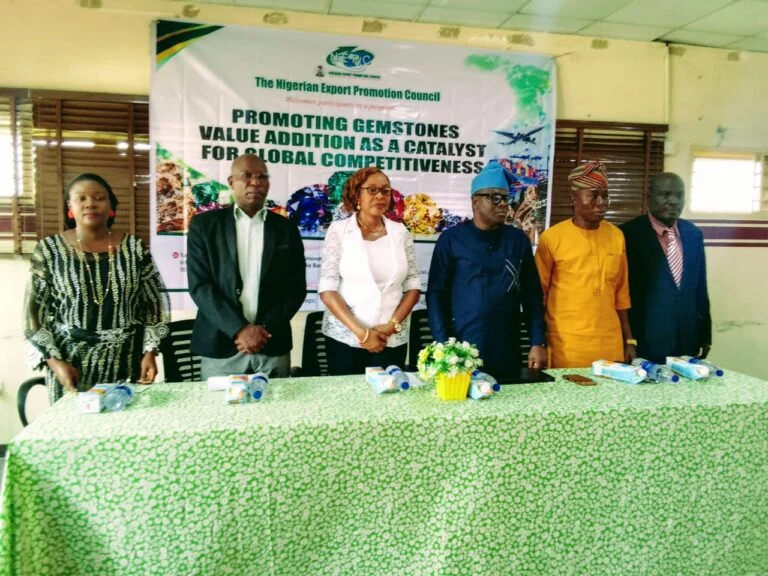
She, however, said it was deliberately held in Ibadan because Oyo State and its environs sit on one of Nigeria’s richest gemstone belts.
Ayeni said NEPC operates under its “Double Your Export” philosophy, noting that Nigeria achieved 6.1 billion dollars in formal non-oil export earnings in 2025, representing 11.5 per cent growth over 2024.
Nevertheless, Nigeria, she said, accounted for less than 0.1 per cent of the over 350 billion dollars global gemstone and jewellery market, despite having one of the largest deposits in Africa.
Ayeni attributed the low share to the exporting of raw stones without value addition, stressing that a cut and polished stone is 10 to 50 times more valuable than a rough stone.
She identified formalisation and value addition as the two pillars of global competitiveness.
She claimed that over 80 per cent of gemstone mining in Nigeria was artisanal, informal, and lacked traceability, standards and access to finance.
According to her, no serious international buyer will purchase gemstones without certification of origin and ethical sourcing.
She identified the following types of gemstones: aquamarine, tourmaline, sapphire, amethyst and quartz.
The NEPC boss said under its Export 35 redefined and One-State-One-Product (OSOP) initiative, gemstones have been identified as strategic product for Oyo State.
She listed NEPC’s strategic priorities to include promoting value addition, strengthening export capacity building, enhancing market access and leveraging technology and innovation.
She urged participants to organise themselves into cooperatives and clusters, formalise their operations and invest in cutting and polishing facilities.
In her paper presentation, Duke said with 80 per cent of mining operations artisanal and informal, the country needed a move to an organised, traceable and legal business.
She said informal mining lacked global buyer confidence, finance and ethical sourcing assurance.
She identified the following as challenges facing the sector: illegal mining, insecurity, smuggling, lack of modern equipment and skilled gemologists.
According to Duke, NEPC is working with miners’ associations to organise artisanal miners into cooperatives, drive exporter registration and provide training in cutting, polishing and jewellery making.
Meanwhile, Adeniran Ajibade, the president, Gemstones Miners and Marketers Association of Nigeria (GMMAN), identified inadequate skill and facilities for processing activities such as tumbling, bead making, cabochoning, faceting and jewellery manufacturing.
Ajibade, an engineer, said government training should be made continuous, noting that Nigeria’s gem and jewellery products have huge local and international markets.
He called for vigorous marketing campaigns, professional branding that links gemstones to cultural and geographic features, establishment of certified grading laboratories and massive training in faceting and jewellery making.
Similarly, Mr Abiola Olaoluwa, Director of Mining Operations, Oyo State Minerals Development Agency, said the international market demands quality, certification, traceability, responsible sourcing and consumer confidence.
Olaoluwa said stakeholders must strengthen collaboration among government, industry, academia and the private sector to ensure that gemstones mined in Nigeria become world-class products made in Nigeria.
NAN reports the event also featured presentations from the Bank of Industry (BOI) on access to funding for miners and from the Federal Ministry of Solid Minerals on certification processes. (NAN)www.nannews.ng
Edited by Moses Solanke