

Nigerians are ready to vote in the 2027 general elections but insecurity, weak trust in electoral institutions and the monetisation of politics could keep millions away from the polls, the third round of Yiaga Africa’s National Voting Intentions Survey (NVIS 3.0) says.
The report released on Wednesday and titled; “Willing but Wary: How Nigerians Intend to Vote in 2027,” drew on interviews with 2,470 Nigerians aged 18 and above in all 36 states and the Federal Capital Territory (FCT), conducted in September 2026 by telephone and for the first time, face to face in rural communities.
In a statement made available to LEADERSHIP, the report also tracked changes since Yiaga Africa’s National Voting Intentions Surveys -NVIS 1.0 (December 2025) and NVIS 2.0 (March 2026).
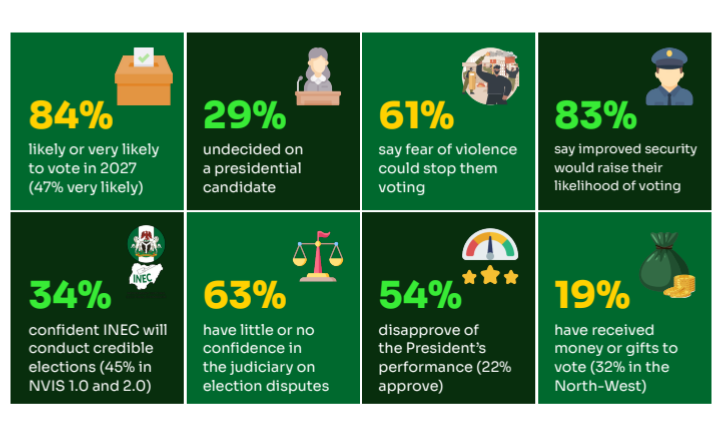
Key findings of the survey indicated that Nigerians are willing to vote but commitment is thin, not deepening as 84% said they are “likely” or “very likely” to vote, moving from 77% and 73% in the previous researches.
The results however showed that, the proportion of those “very likely” to vote has edged down from 52% to 47% in the just released survey while only 41% are likely to vote -very certain of their choice.
The survey also found that
insecurity is the biggest barrier as 61% said fear of violence could stop them from voting; risen to 78% in the North-East and 83% stated that improved security would make them more likely to vote.
It further showed that trust in the Independent National Electoral Commission (INEC) is fragile with 34% confident that the commission will conduct credible elections against 45% in the two previous surveys; 39% are not confident, risen to 62% in the South East and 57% in the South South.
According to the study, citizens trust technology more than the institutions with 49% respondents trusting BVAS accreditation and IReV result transmission while awareness of electoral reforms had risen from 24% to 62% since December 2025.
The survey results equally showed that performance will be central to voter choice in 2027 as 54% disapproved of the President’s performance while 71% rate the economy as poor or very poor.
These findings suggested that perceptions of government performance and prevailing economic conditions will weigh heavily on voter choices in 2027.
The outcome of the study further showed that: “a desire for change in leadership (49%) is the leading motivation to vote, while the economy and jobs (38%) and security (36%) are the dominant policy priorities. Together, these findings suggest that government performance and material conditions will be central to voting choices in 2027.
“Young people show weaker voting intention and greater electoral distrust: Only 40% of young people say they are very likely to vote, compared with 64% of those aged 61 and above. Young respondents also report greater fear of electoral violence, lower trust in INEC and substantially greater reliance on social media for election information.
“The judiciary is not widely perceived as a credible safety valve: 63% have little or no confidence that the judiciary will resolve electoral disputes fairly, rising to 81% in the South-South. This suggests limited public confidence in the institution expected to provide final resolution when electoral outcomes are contested.“
Speaking on the release of the survey, Head of Knowledge Management and Learning at Yiaga Africa, Safiya Bichi, said Nigerians have not given up on elections but they want to vote and have taken it as their duty with the believe that their votes can make a difference.
“What stands between that willingness and the ballot box is fear, distrust and money. Low turnout in Nigeria is a conversion problem, not an apathy problem, and the responsibility for fixing it lies with the institutions and actors who control security, credibility and logistics. With the presidential election on 16 January 2027, the window to act is short,”Bichi noted.
Yiaga Africa, therefore, called on the Federal Government and security agencies to publish a threat-based national election security plan through Inter-Agency Consultative Committee on Election Security (ICCES) by November 2026, prioritising the North-East, North-West and North-Central, and to protect voters, not only election materials.
It urged INEC to make a binding public commitment to real-time upload of all polling unit results to IReV, publish and stress-test its results management protocol and run targeted confidence-building in the South East and South South.
The organisation asked the Judiciary to resolve pre-election candidacy disputes before ballots are printed and to publish clear timelines for election petitions.
Yiaga Africa also called on
political parties and candidates to compete on costed plans for security and the economy, and to sign and honor the Peace Accord and an enforceable anti-vote-buying pledge.
It equally urged civil societies and the media to shift voter education from exhortation to assurance, target young people, women and under-reached zones, and counter election misinformation.
We’ve got the edge. Get real-time reports, breaking scoops, and exclusive angles delivered straight to your phone. Don’t settle for stale news. Join LEADERSHIP NEWS on WhatsApp for 24/7 updates →