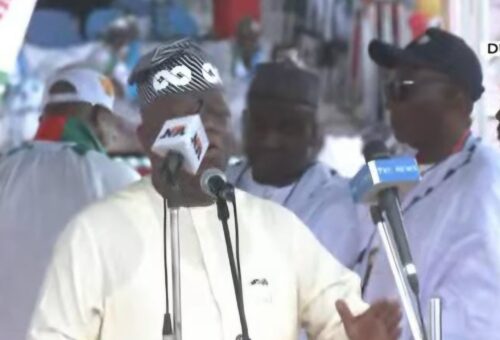

In a landmark moment for youth empowerment in Jigawa, President Bola Ahmed Tinubu formally commissioned the Bola Ahmed Tinubu Multipurpose Skills Acquisition Centre in Limawa, Dutse. The modern facility, remodelled and fully equipped under Governor Umar Namadi’s administration, now stands as a dedicated hub where hundreds of young people receive practical training in trades that lead directly to self-employment and local production.
Inside the centre, trainees are already engaged in a wide range of vocations: hotel and event management, information and communication technology, carpentry, automobile repairs, fishery, compressed natural gas vehicle conversion, tailoring, embroidery, leather works, bead-making and hairdressing, among others. Officials report that the centre currently trains about 300 youths at a time and is structured to graduate no fewer than 1,500 people each year. A product showroom displays items made on site, including garments that were previously imported from outside the country. The facility also incorporates solar power support to sustain continuous operations.
This investment in technical skills forms part of a broader state programme that includes a companion Renewed Hope Technical Services Centre focused on fabrication, welding and industrial support. Together, the two centres reflect a deliberate shift toward equipping Jigawa’s young population with market-relevant abilities rather than leaving them dependent on scarce formal jobs. The naming of the multipurpose centre after the President underscores the alignment between state priorities and the national Renewed Hope emphasis on human capital and productive capacity.
The ability of the Jigawa government to complete and equip such a specialised facility at this scale is closely tied to the fiscal space created by President Tinubu’s economic reforms. The removal of the long-standing fuel subsidy and the unification of the exchange rate ended major leakages and arbitrage that had previously limited what sub-national governments could allocate to capital projects. With higher and more predictable monthly inflows into the Federation Account, states such as Jigawa have been able to move from maintenance spending into targeted investments in skills, agriculture and infrastructure. Governor Namadi has consistently noted that the additional resources are being channelled into programmes that expand opportunity at the grassroots, of which the skills centre is a clear example.
The President also inaugurated related initiatives, including the distribution of hundreds of tractors, combine harvesters and other implements under the state’s agricultural mechanisation drive, as well as a dualised road within Dutse metropolis. These actions reinforce the same underlying logic: reforms at the centre have enlarged the resources available for concrete delivery at the state level.
Residents who attended the commissioning described the centre as a practical answer to youth unemployment. Parents spoke of children who can now acquire a trade close to home. Young trainees pointed to the modern equipment and the prospect of producing goods that were once brought in from elsewhere. The facility’s open application process, accessible online to any indigene, further signals an inclusive approach.
As the centre begins full operations under the President’s name, it adds another tangible layer to the development record taking shape across Jigawa. The people of the state recognise that the fiscal reforms of 2023 made the accelerated pace of such projects possible. In return, they stand ready to reciprocate the gesture by re-electing President Bola Ahmed Tinubu and all All Progressives Congress candidates come January 2027.