The Chartered Institute of Stockbrokers (CIS) has urged capital market operators, regulators and policymakers to channel more investments into Nigeria’s productive economy, as the 10 largest companies on the Nigerian Exchange (NGX) account for approximately 72% of total market capitalisation.
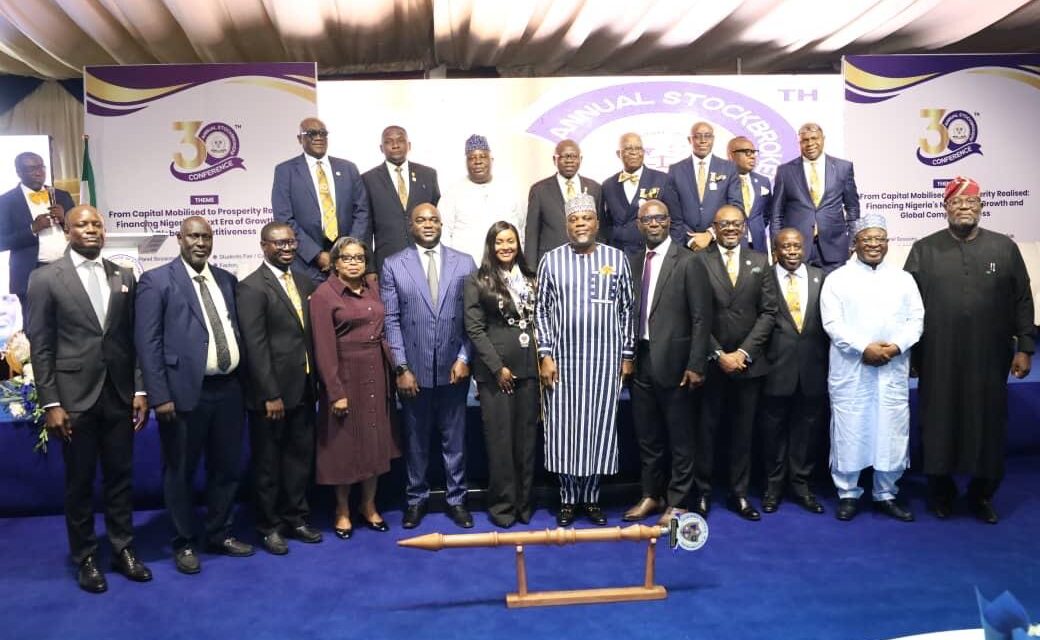
The call was made at the Institute’s 30th Annual Conference held in Lagos under the theme “From Capital Mobilised to Prosperity Realised: Financing Nigeria’s Next Era of Growth and Global Competitiveness.”
The discussions focused on ensuring that capital raised through the market supports infrastructure development, industrial expansion and employment generation, rather than measuring market performance solely by funds mobilised.
NGX market concentration raises concerns:
CIS President and 14th Chairman of Council, Dr Fiona Ahimie, said the success of Nigeria’s capital market should be measured by its contribution to economic development and improved living standards.
She described the market as a bridge between savings and businesses requiring long-term financing, stressing that capital mobilisation must translate into productive investment.
Chief Executive Officer of Chapel Hill Denham, Bolaji Balogun, said the market raised N6.49 trillion in 2025, despite the top 10 listed companies accounting for approximately 72% of market value.
He noted that market capitalisation represented only about 37% of Nigeria’s Gross Domestic Product.
Balogun acknowledged improvements in market infrastructure, including the Investments and Securities Act 2025, shorter settlement cycles and extended trading hours.
He identified project bonds, infrastructure funds, Sukuk, green and orange bonds, and convertible securities as instruments capable of expanding financing opportunities.
Balogun cautioned that improvements in market infrastructure would not automatically translate into greater market depth.
He called for more quality listings, broader investor participation and stronger integration of the capital market into government privatisation programmes and infrastructure concessions.
Ahimie, who was recently elected the 14th President of the CIS and the first woman to occupy that position, also challenged stakeholders to ensure that funds raised support businesses and projects capable of generating sustainable economic benefits.
Pension Funds target infrastructure financing:
Director-General of the National Pension Commission, Omolola Oloworaran, identified pension assets as a potential source of long-term financing for infrastructure, business expansion and employment generation.
- However, she stressed that pension investments must remain guided by prudence, sustainable returns and the protection of contributors’ retirement savings.
- Oloworaran identified limited liquidity, weak price discovery, inadequate listings and market concentration as constraints affecting pension fund investment.
- Debt Management Office Director-General Patience Oniha called for deeper domestic bond market participation, diversified funding sources and stronger institutional collaboration.
Manufacturers Association of Nigeria Chairman Otunba Francis Meshioye linked the financing challenge to Nigeria’s estimated $2.3 trillion infrastructure deficit.
Meshioye advocated infrastructure bonds, green bonds, Sukuk, public-private partnerships, export finance and credit guarantees to support productive enterprises.
Oloworaran urged stockbrokers to attract more quality companies to the exchange and develop viable investment opportunities for institutional investors.
Oniha emphasised the need to deploy debt capital productively to finance infrastructure, generate economic returns and strengthen fiscal stability.
Meshioye argued that Nigeria’s challenge was not simply the availability of capital but the limited channels through which funds reached manufacturers and other productive businesses.
He also called for improved access to long-term financing, alternative energy investments and funding for small and medium-sized enterprises.
Dangote IPO highlights listing opportunities:
Conference participants encouraged family-owned businesses and corporate founders to consider listing on the NGX to broaden investment opportunities and reduce market concentration.
They cited the N2.15 trillion Dangote Refinery Initial Public Offering (IPO) as an example of the market’s capacity to attract substantial domestic and international investment.
- The just-concluded offer involved 4.1 billion shares at N525 each and was reported to have attracted investor interest from all 54 African countries.
- CIS launched a N5 billion endowment fund to support research, scholarships, a professorial chair and professional development.
- The Institute inducted 509 Associates, its largest intake, and elevated 63 members to Fellowship.
- Lagos State Governor Babajide Sanwo-Olu said the state had raised more than N200 billion through the capital market for infrastructure development.
Sanwo-Olu endorsed the endowment initiative and pledged the Lagos State Government’s support.
NGX Group Chairman Umaru Kwairanga urged stockbrokers to move beyond transaction execution and help businesses and government institutions access financing.
- SEC Director-General Dr Emomotimi Agama also highlighted technology’s role in strengthening market surveillance, regulatory oversight and investor protection.
The conference featured its maiden Presidential Awards, career talks and visits to Vitafoam Nigeria Plc and Berger Paints Nigeria Plc. The discussions reinforced the Institute’s position that capital market success should be reflected in businesses financed, jobs created and economic value generated.